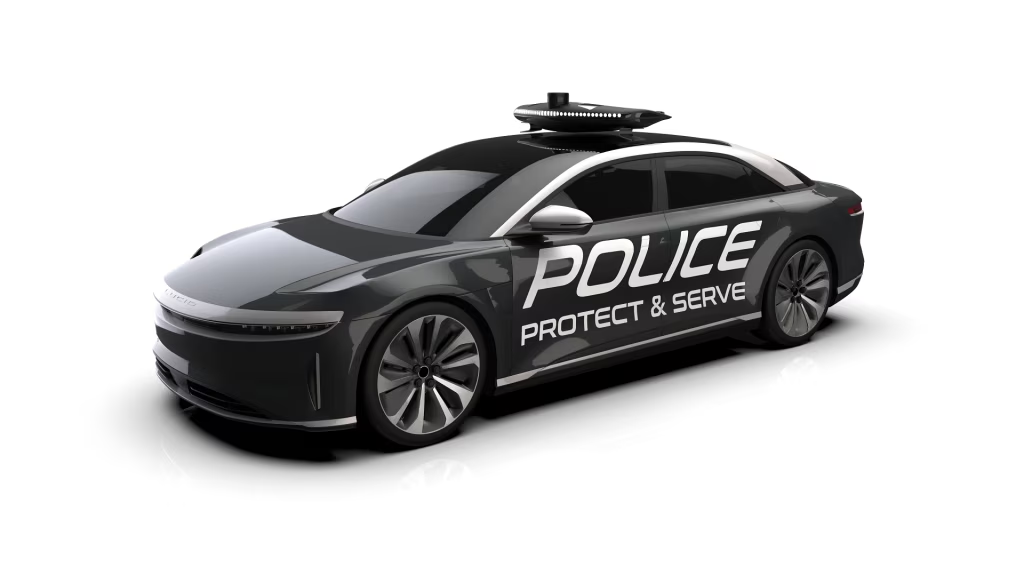
In a bold stride toward a fully automated future, Dubai has officially introduced autonomous police vehicles to patrol its streets. This move is not merely a technological showcase but a strategic implementation of artificial intelligence in public safety. The Dubai Police Force, known globally for its fleet of luxury supercars and forward-thinking initiatives, has now added driverless patrol cars to its arsenal signaling a major shift in how law enforcement could function in the decades ahead.
As cities around the world grapple with rising populations and increasing demands on public safety resources, Dubai is positioning itself as a testing ground for next-generation urban security. The deployment of autonomous police vehicles is part of the broader Dubai Smart City transformation, a government-led vision to make the emirate the world’s smartest and safest city by 2031.
But what exactly are these vehicles capable of? How do they operate without human intervention? And what does this mean for the future of policing not just in the UAE, but globally? This article explores every facet of Dubai’s driverless police initiative, from its technological backbone to its societal implications.
1. The Technology Behind Dubai’s Driverless Police Vehicles
A. Artificial Intelligence and Machine Learning
At the heart of Dubai’s autonomous police vehicles lies a sophisticated artificial intelligence system. These vehicles are not pre-programmed to follow fixed routes; instead, they learn from their environment. Using machine learning algorithms, they can identify patterns in criminal behavior, recognize suspicious activities, and even predict potential security threats before they escalate.
The AI continuously improves through real-world data collection. Every patrol, every interaction, and every mile driven adds to the system’s intelligence, making future operations more efficient and precise.
B. Sensor Fusion and 360-Degree Awareness
To navigate the chaotic and unpredictable environment of urban streets, these vehicles rely on a combination of sensors:
-
LiDAR (Light Detection and Ranging): Creates a real-time 3D map of the surroundings.
-
High-definition cameras: Capture visual data for facial recognition and license plate scanning.
-
Radar systems: Detect objects in adverse weather conditions or low visibility.
-
Ultrasonic sensors: Assist in close-range maneuvering and parking.
This sensor fusion allows the vehicle to maintain full awareness of its surroundings at all times, ensuring safe navigation even in heavy traffic or crowded pedestrian zones.
C. 5G Connectivity and Real-Time Communication
Dubai’s smart infrastructure plays a critical role in the success of these autonomous vehicles. With 5G networks blanketing key areas of the city, the patrol cars maintain constant, low-latency communication with Dubai’s central command center. This enables:
-
Instantaneous data sharing
-
Remote override capabilities in emergencies
-
Live video streaming to human operators
-
Synchronization with traffic lights and smart road systems
The result is a seamlessly integrated security network where vehicles, infrastructure, and command centers operate as a single organism.
2. Design and Physical Specifications
A. Compact and Agile Form Factor
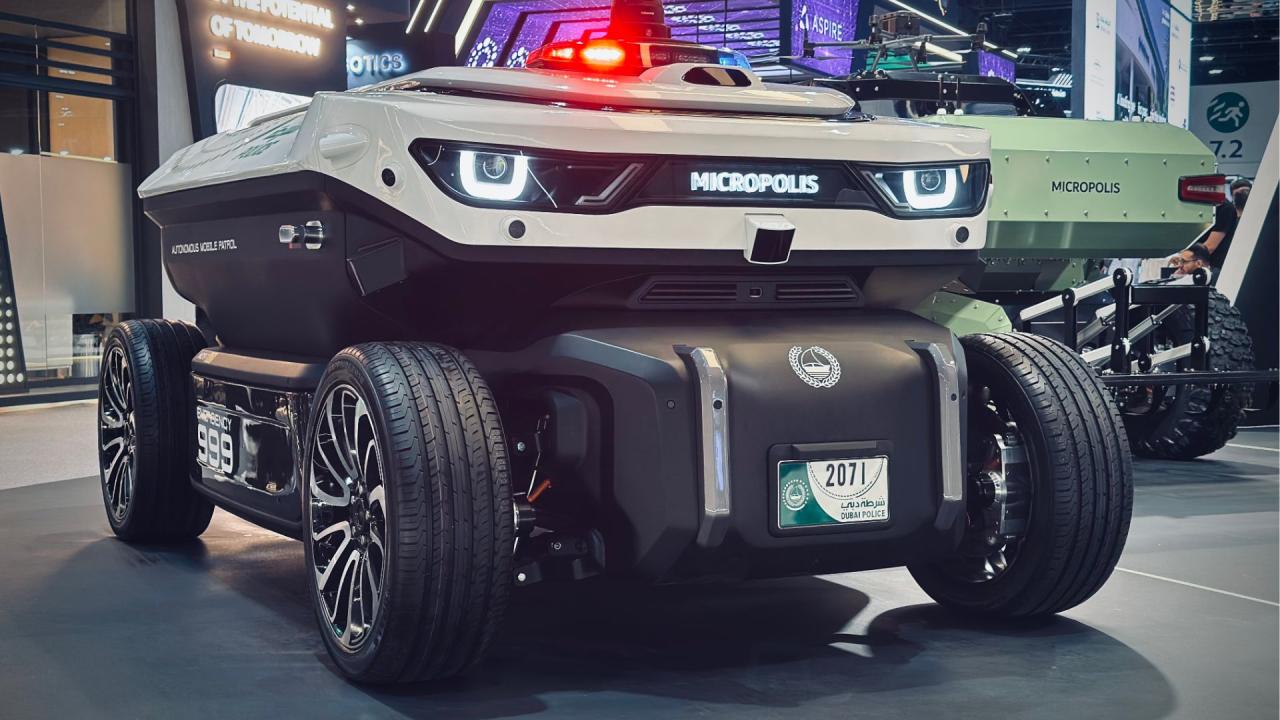
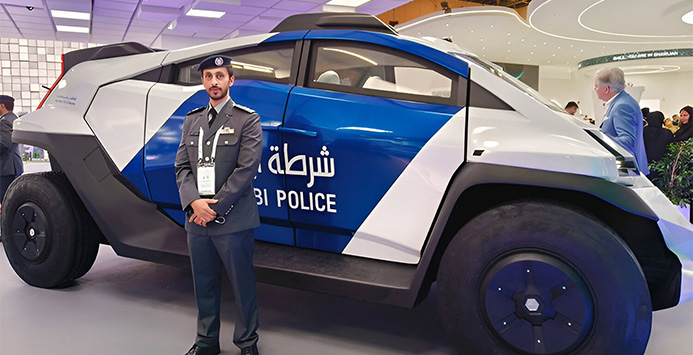
Unlike the bulky, militarized unmanned ground vehicles seen in some other nations, Dubai’s driverless police cars are sleek and compact. Designed for urban maneuverability, they can navigate narrow alleyways, roundabouts, and high-density residential areas with ease.
The vehicles are electric, aligning with Dubai’s sustainability goals under the Dubai Clean Energy Strategy 2050. Their silent operation also makes them ideal for discreet surveillance operations.
B. Onboard Equipment and Payload
Despite their modest size, these vehicles are equipped with a surprising range of tools:
-
Built-in drones: Some models feature roof-mounted drone docking stations. When a situation requires aerial surveillance, the drone launches autonomously, provides a bird’s-eye view, and returns to the vehicle when the mission is complete.
-
Biometric scanners: Facial recognition technology allows the vehicle to cross-reference faces with databases of wanted individuals.
-
Emergency response tools: First aid kits, fire extinguishers, and communication devices for civilians in distress.
-
Interactive display screens: Citizens can approach the vehicle and communicate with a remote operator via two-way audio-visual systems.
3. Operational Capabilities and Use Cases
A. Routine Patrol and Visible Deterrence
The primary function of these autonomous vehicles is visible patrol. Their presence alone serves as a deterrent to petty crime. Whether parked at a busy intersection or slowly cruising through a commercial district, they signal that law enforcement is always watching.
B. Smart Surveillance and Threat Detection
Using onboard cameras and AI analytics, the vehicles continuously scan for:
-
Unattended bags or suspicious objects
-
Aggressive behavior or physical altercations
-
Traffic violations and illegal parking
-
Wanted vehicles through automatic license plate recognition
When a potential threat is identified, the system immediately alerts human operators at the command center, who can then assess the situation and deploy additional resources if necessary.
C. Community Interaction and Public Service
Dubai Police has emphasized that these vehicles are not intended to replace human officers entirely. In fact, one of their key roles is community engagement. Citizens can interact with the vehicle via touchscreen interfaces to:
-
Report a crime or emergency
-
Access police services such as lost property reports
-
Receive safety alerts and public announcements
This human-machine collaboration model ensures that technology enhances—not erodes—public trust in law enforcement.
D. Crowd Monitoring During Events
Dubai hosts hundreds of large-scale events each year, from the Dubai Shopping Festival to international sports competitions. Autonomous patrol vehicles can be deployed to monitor crowd density, detect stampede risks, and identify individuals acting suspiciously. Their ability to operate continuously without fatigue makes them invaluable during extended events.
4. Strategic Goals: Why Dubai Is Leading the Charge
A. Vision 2031: The World’s Smartest City
Dubai’s autonomous police vehicles are not a standalone novelty. They are a component of a much larger strategic roadmap. The Dubai Smart City initiative aims to digitize every aspect of urban life, from transportation and energy to healthcare and security.
By 2031, Dubai expects 25% of all police patrols to be conducted by autonomous systems. This aligns with the UAE’s broader goal of becoming a global leader in AI adoption.
B. Reducing Human Error and Enhancing Efficiency
Human officers are subject to fatigue, emotional bias, and physical limitations. Autonomous systems, by contrast, are tireless, objective, and capable of processing vast amounts of data in milliseconds. This shift is expected to:
-
Reduce response times
-
Lower operational costs
-
Minimize risks to officers in dangerous situations
-
Improve accuracy in surveillance and evidence collection
C. Global Leadership in AI Policing
Dubai has long understood that being a first mover in emerging technologies yields diplomatic and economic dividends. By deploying autonomous police vehicles now, the emirate gains invaluable real-world data, patents, and expertise. This knowledge can later be exported to other nations, positioning Dubai as a hub for security tech innovation.
5. Public Reception and Ethical Considerations
A. Enthusiasm and National Pride
Among residents and citizens, the response has been largely positive. Many Emiratis view the initiative as a source of national pride—a sign that their country is not just keeping up with the future but shaping it. Tourists, too, are often intrigued by the sight of driverless patrol cars, adding to Dubai’s reputation as a futuristic destination.
B. Privacy and Surveillance Concerns
However, not all feedback has been glowing. Privacy advocates have raised concerns about the proliferation of facial recognition technology and continuous monitoring. Critics argue that even if data collection is anonymized and regulated, the presence of AI-driven surveillance could lead to a chilling effect on public behavior.
Dubai Police has responded by emphasizing that all data is encrypted, stored securely, and used strictly for law enforcement purposes. The UAE also has data protection laws in place, though independent oversight remains a topic of ongoing debate.
C. Job Displacement Fears
Another common concern is the potential displacement of human workers. If autonomous vehicles take over patrol duties, what becomes of the officers who traditionally performed those roles?
Dubai Police has clarified that the goal is augmentation, not replacement. Human officers will be redeployed to more complex, high-judgment tasks such as criminal investigations, community outreach, and crisis negotiation. The autonomous systems handle routine, repetitive tasks freeing up human talent for work that requires empathy, creativity, and moral reasoning.
6. Comparison with Global Initiatives
A. Singapore: Autonomous Patrols in Public Housing
Singapore has tested autonomous security robots in public housing estates. These robots patrol common areas, detect “undesirable social behaviors,” and alert human supervisors. While similar in concept, Singapore’s robots are ground-based units rather than full-sized vehicles, and their capabilities are more limited.
B. United States: Pilot Programs in Several Cities
In the U.S., several cities have experimented with autonomous security vehicles, particularly in private communities and corporate campuses. However, regulatory hurdles and public skepticism have slowed widespread adoption. Dubai’s centralized governance model allows for faster implementation.
C. China: AI-Integrated Policing
China has deployed autonomous patrol vehicles in select cities, often equipped with facial recognition and loudspeakers for public announcements. While technologically advanced, these systems are typically used in controlled environments rather than open public roads.
Dubai’s approach stands out for its ambition, integration with smart city infrastructure, and emphasis on public interaction.
7. Challenges and Limitations
A. Technical Constraints
No autonomous system is perfect. Edge cases such as unpredictable pedestrian behavior, extreme weather, or deliberate tampering pose ongoing challenges. While Dubai’s vehicles are highly advanced, they are not yet capable of handling every possible scenario without human intervention.
B. Cybersecurity Risks
As with any connected device, autonomous police vehicles are potential targets for cyberattacks. A compromised vehicle could be used as a weapon or disrupt public safety operations. Dubai Police has invested heavily in encryption, penetration testing, and secure communication protocols, but the threat landscape continues to evolve.
C. Legal and Liability Questions
If an autonomous vehicle causes an accident or fails to prevent a crime, who is legally responsible? The manufacturer? The police department? The AI developer? These questions remain unanswered in many jurisdictions, including the UAE. Clear legal frameworks will be essential as autonomous systems take on greater responsibility.
8. Future Developments: What Comes Next?
A. Integration with Autonomous Ambulances and Fire Trucks
Dubai is reportedly exploring the development of autonomous emergency response vehicles. In the future, a coordinated fleet of driverless police cars, ambulances, and fire engines could respond to incidents in perfect synchronization, with minimal human oversight.
B. AI-Powered Predictive Policing
Beyond patrol, Dubai Police is investing in predictive analytics. By analyzing crime data, weather patterns, social media activity, and even economic indicators, AI systems may eventually forecast where and when crimes are likely to occur allowing preemptive deployment of resources.
C. Public Trials of Autonomous Arrest Capabilities
While current vehicles are non-confrontational, future iterations may include non-lethal intervention tools such as net launchers, acoustic devices, or automated barrier deployment. Such capabilities would, of course, require rigorous legal and ethical review.
9. Conclusion: A Glimpse Into Tomorrow’s Cities
Dubai’s driverless police vehicles are more than a headline-grabbing innovation. They represent a fundamental shift in the philosophy of public safety. By embracing automation, artificial intelligence, and real-time data integration, Dubai is building a security model that is proactive rather than reactive, efficient rather than labor-intensive, and scalable rather than static.
Of course, challenges remain. Privacy concerns, technical limitations, and ethical dilemmas will require ongoing dialogue and careful regulation. But one thing is clear: the era of autonomous policing has begun. And Dubai, as always, is driving at the front of the pack.
As other cities watch and learn, the question is no longer whether autonomous patrol vehicles will become commonplace, but how quickly and how responsibly we choose to adopt them.